
Encouragement to rest, to take breaks, and to avoid pressure is common and at times, it’s necessary.
Pushing children to keep going, to never give up, and to strive to be the best at everything is not always a great fit.
But just as important is something that is often overlooked:
children need challenge, consistency, and the experience of working through difficulty in order to grow.
The challenge is not deciding what sounds right.
It’s understanding what is actually needed in the moment — and helping children act on it.
Because that’s where habits begin.
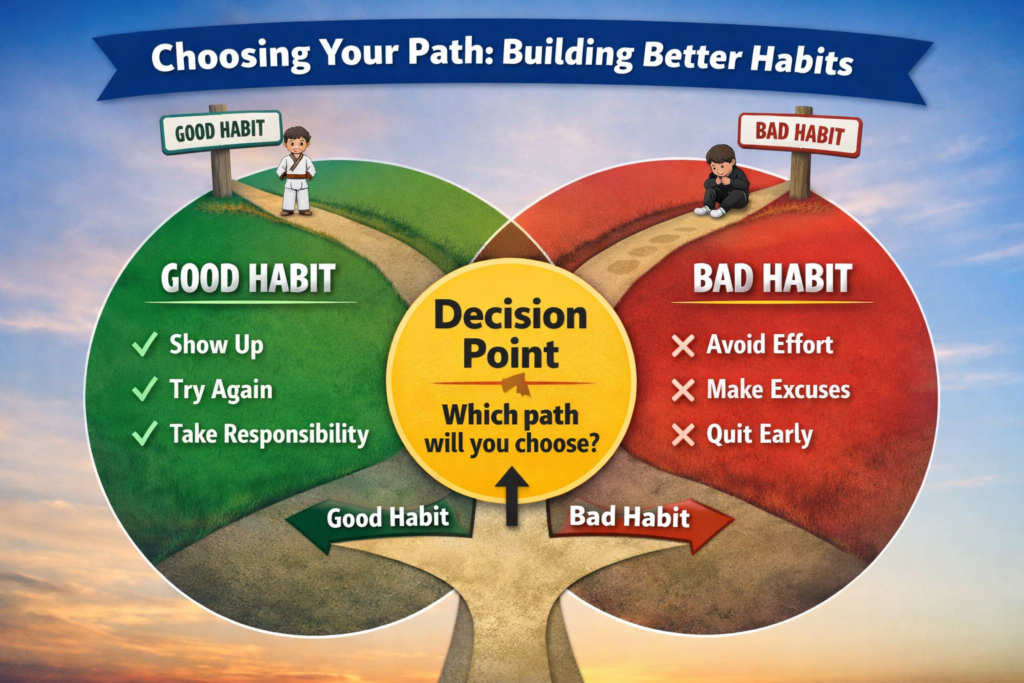
Every time a child feels challenged, tired, or unsure, they arrive at a simple decision point:
👉 Do I show up and try again?
👉 Or do I avoid it and choose what’s easier?
Most of these decisions seem small at the time.
But over days and weeks, they begin to shape patterns — and those patterns become habits.
And those habits shape confidence, behaviour, and long-term outcomes.
💠Dave didn’t grade because he wasn’t ready. Instead of focusing on what he needed to improve, he began complaining about headaches after school and avoided training.
💠Sara didn’t score as many goals in hockey as she wanted. Instead of seeing it as something to work on, she decided she “wasn’t good” and wanted to quit.
💠Another student struggles with a new skill in class. Rather than practicing, they decide it’s too hard and lose interest.
💠A child has homework to complete, but chooses screens first, then later feels too tired to finish.
These moments seem small, but they are important. Each one is a decision point.
Research in child development and sport (Côté, Ericsson, and Sport Australia frameworks) shows that children benefit from both variety and consistency trying different activities, while staying with them long enough to build skill and confidence.
Commitment isn’t something children are born with. It’s built with guidance.
Each time a child shows up when they don’t feel like it, tries again after a mistake, or finishes what they started, they strengthen a habit of following through.
On the other hand, avoiding effort or stepping away too early builds a different habit.
These decisions don’t seem important at the time. But over weeks and months, they shape how a child approaches everything.
One of the most important lessons children can learn is how to look inward and be honest with themselves.
It’s easy to say:
“I’m too busy.”
“I’m too tired.”
“I’ll do it later.”
But often, those aren’t the real reasons. It is a little deeper.
More often, it’s a choice between what feels easy or comfortable and what actually needs to be done.
And in those small moments, habits begin to form.
One of the biggest challenges today isn’t a lack of ability ….. it’s distraction.
Screens, games, and constant entertainment make it easy to avoid effort. Over time, children can start to believe they are “too busy” for the things that matter, when in reality they are simply choosing easier options.
This is why awareness is so important.
When children begin to recognise the difference between being genuinely busy and being distracted, they can start to take control of their habits instead of being controlled by them.
Children don’t develop commitment by staying comfortable.
They develop it through challenge in the right environment, at the right level.
Research shows that children benefit from variety and new learning. Being exposed to different types of movement and problem-solving helps build coordination, confidence, and adaptability. The younger the children are, the more that this is the case.
But variety on its own isn’t enough.
Children also need to stay with something long enough to experience progress.
Here is how we do it……… a child might learn different types of skills across a few classes. Ground-based movement and escapes, striking and blocking, or simple self-defence concepts that relate to the school yard. Each session may feel different, but the underlying process is the same.
They are:
Over time, they begin to understand that improvement doesn’t happen straight away.
They learn to stay engaged when something is difficult, to work through frustration, and to keep trying when things don’t go their way.
This is where commitment starts to take shape.
Without challenge, there is no reason to persist.
Without persistence, there is no real progress.
When children experience variety within a consistent and structured approach, they don’t just develop skills — they develop confidence in their ability to handle difficulty, both physically and mentally.
The goal isn’t to push children endlessly.
Rest is important. Recovery is important.
But so is effort.
So is learning to do something even when you don’t feel like it…..make it a habit.
Commitment isn’t about motivation.
It’s about what you do when motivation isn’t there.
And habits aren’t built in big moments.
They’re built quietly, through small decisions, every day.
The earlier children learn this,
the stronger, more capable, and more confident they become.