
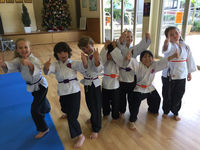
A pre-schooler standing proudly in attention stance, remembering to wait for their turn or trying again after missing a movement might not look like a major achievement.
For a young child, these are meaningful moments of learning.
Introducing pre-schoolers to martial arts is not about creating tiny fighters or expecting adult levels of discipline. It is about giving children a positive place to practise movement, listening, confidence and self control.
The right first experience should be active, enjoyable and structured around how young children actually learn.
There is no single personality type that suits martial arts.
An energetic child may enjoy having a constructive place to move. A quieter child may benefit from a familiar routine and opportunities to participate at their own pace.
Being ready does not mean that a child can already stand still, follow every instruction or confidently leave their parent.
Those are some of the skills they are coming to learn.
A child may be ready to begin if they are becoming curious about group activities, enjoy copying movements or can attempt a simple instruction with support. They do not need to demonstrate all of these things perfectly.
The first few classes help the child, parent and instructor decide whether the environment and timing are right.
Children aged three to five are not small versions of older martial arts students.
They need shorter instructions, regular changes of activity and opportunities to learn through imagination, repetition and movement.
At Southern Cross Martial Arts, our Little Dragons classes are 30 minutes long. This gives children enough time to participate and learn without expecting them to maintain attention beyond what is reasonable for their age.
We also maintain a smaller student to instructor ratio for our younger classes. This allows instructors to notice when a child needs extra explanation, encouragement or help returning to the activity.
The standard remains meaningful, but the way children reach that standard is appropriate for their development.
Learn more about our martial arts classes for children aged three to five.
Pre-schoolers learn best when they are moving, exploring and enjoying the activity.
Our instructors use games and Game Sense activities to introduce martial arts and underpinning movement skills.
A child may think they are playing a balance game, moving around an obstacle or racing to the correct marker. The instructor sees an opportunity to develop coordination, spatial awareness, listening and decision making.
Simple pad activities can teach safe distance and body control. Ground movement can help children become comfortable getting down and standing up. Taking turns with a partner introduces cooperation and patience.
The activities are fun, but they are not without purpose.
Children gradually experience foundations connected to our wider martial arts curriculum, including striking, fitness, ground movement, pad work, agility, kata and personal safety.
A parent or guardian must remain at the venue for the entire preschool class.
These are very young children, and having a familiar adult nearby provides reassurance if they become overwhelmed, need the toilet or require help that falls outside the instructor’s role.
Remaining present also allows parents to see how the class is taught and understand the language and expectations being introduced.
Parents can support the class by being encouraging without providing a second set of instructions from the side. If the instructor asks children to stand in attention stance, for example, it is usually best to give the child a moment to hear and respond before repeating the instruction for them.
The instructor will let parents know when their help is needed.
Some preschoolers join the class independently from their first visit. Others need a parent beside them on the training floor, particularly when the environment is new.
This is not a failure or a sign that martial arts is unsuitable.
A parent may initially complete activities alongside their child, help them move between stations or provide the reassurance they need to remain involved.
The parent’s role should be guided by the instructor. The aim is to support participation while gradually allowing the child to build trust in the coach and confidence within the group.
This may happen during the first class or develop over several visits. As the child becomes comfortable, the parent can begin stepping back for part of an activity and eventually return to watching from the side.
Independence is encouraged, but it does not need to be forced.
The physical techniques are only one part of preschool martial arts.
Children also practise:
Listening to a short instruction
Returning their attention after becoming distracted
Waiting for a turn
Moving safely around other people
Using equipment appropriately
Speaking clearly when prompted
Trying again when something is difficult
Keeping their hands and feet under control
These skills can support participation in school, sport and other group activities.
Listening and focus are developed through short and achievable tasks. We do not expect a pre-schooler to remain perfectly still for long periods.
The goal is for them to practise returning their attention when the instructor provides a cue.
Keep your explanation simple before the first visit.
Tell your child that they will meet an instructor, play movement games, listen to a few rules and try some new activities.
Avoid presenting the class as a test or telling them they must be brave, behave perfectly or complete everything. Curiosity is a better starting point than pressure.
It can also help to:
Arrive early enough for your child to look around
Make sure they have used the toilet
Provide a snack beforehand if needed
Dress them in comfortable clothing
Tell the instructor about any concerns
Allow them time to observe before joining
A rushed arrival can make an unfamiliar activity feel harder than it needs to be.
Progress is not measured only by kicks, belts or perfect technique.
For a pre-schooler, progress may mean walking onto the training floor with less assistance, joining one more activity or listening to an additional instruction.
It may be waiting more patiently, recovering faster after disappointment or moving into attention stance when the instructor gives the cue.
These small changes matter.
Young children will still have tired, distracted and emotional days. One difficult class does not erase their progress, just as one confident class does not mean they will never need support again.
Consistency, realistic expectations and communication between parents and instructors give children the best opportunity to settle into the routine.
A strong first martial arts experience is one where a child feels safe enough to participate, supported enough to make mistakes and proud enough to keep trying.