
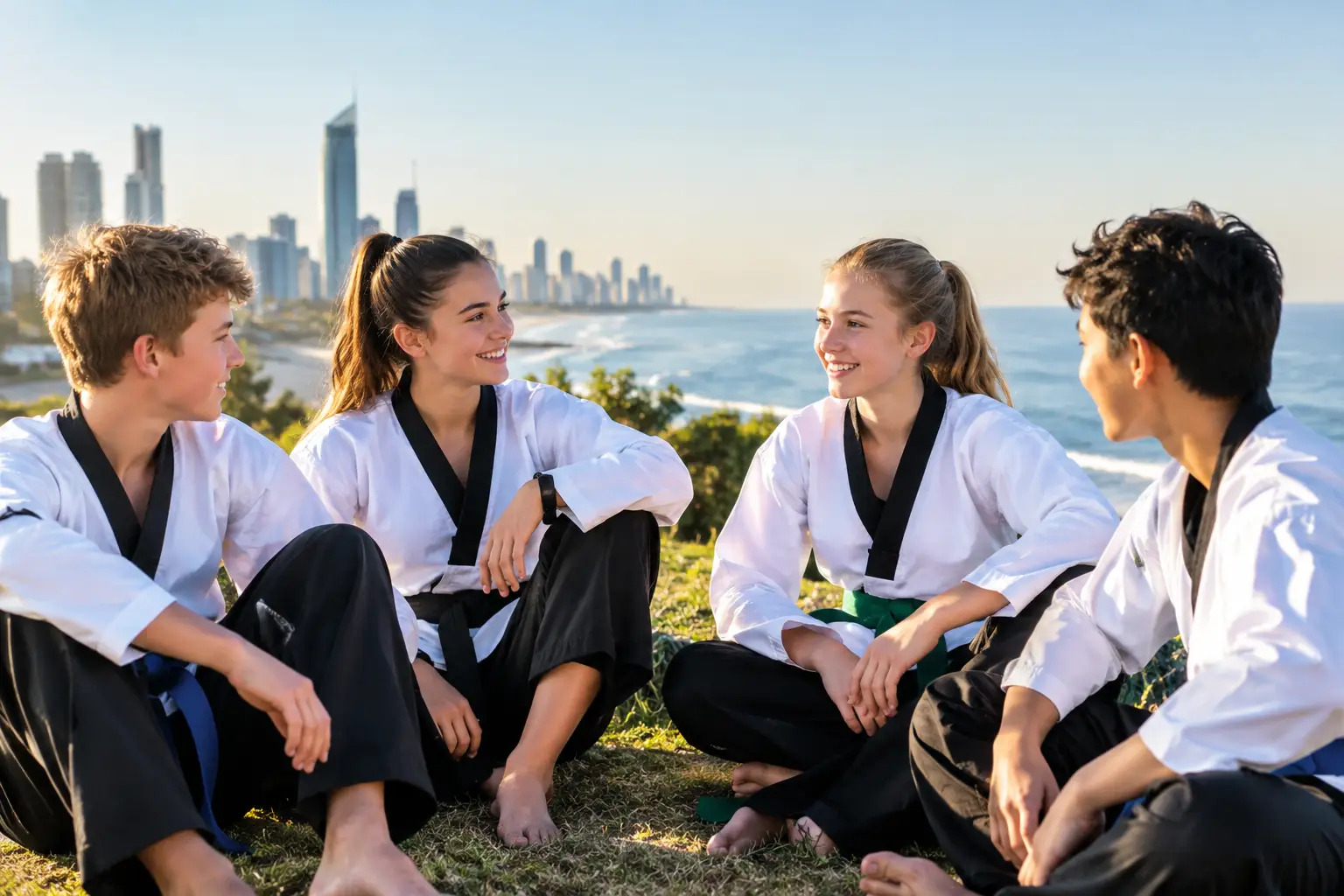
A teenager who spends most afternoons scrolling, gaming or drifting between plans does not necessarily need another lecture about screen time. Often, they need a regular commitment that feels worthwhile: somewhere to move, learn, be known by good people and see that effort leads somewhere. That is why Gold Coast teen activities are worth choosing carefully. The right activity can offer more than entertainment for an hour or two. It can give a young person a constructive rhythm through a stage of life that is changing quickly.
For many families, martial arts is a strong fit because it combines physical challenge with clear expectations and a supportive group environment. It is not about turning teenagers into fighters or expecting training to solve every confidence, behaviour or social challenge. It is about giving them practical skills, steady coaching and opportunities to practise showing up, working through difficulty and treating others well.
Teenagers need different things at different times. One may be naturally sporty but tired of team selection and weekend competition. Another may avoid organised sport because they feel behind, self-conscious or unsure where they fit. Some need a healthy outlet after a long school day; others need a community outside their friendship group, school or screen.
A worthwhile activity should leave room for all of these realities. It should provide enough structure that students know what is expected, but enough variety that training does not become repetitive. It should welcome beginners without holding back the students who have trained for years. Most importantly, it should give teenagers a chance to improve through practice rather than relying on natural ability alone.
That is a valuable lesson at an age when comparison can be loud. In a well-run martial arts class, progress is not reserved for the loudest, strongest or most athletic student. A quieter teenager can improve their stance, fitness, coordination, partner work and decision-making one session at a time. The work is visible, and that matters.
There is plenty to do on the Gold Coast, from beach afternoons and social sport to creative groups and casual jobs. Each has a place. The trade-off is that unstructured activities can depend on weather, friends being available or a teenager feeling motivated on the day. A structured weekly class creates a different kind of consistency.
Martial arts training has a clear beginning and end to each session. Students warm up, practise skills, work with partners, develop fitness and finish with a sense of what they have learned. The routine is not rigid for its own sake. It helps teenagers settle into the session, focus on the task in front of them and understand that improvement comes from repeated, thoughtful practice.
At Southern Cross Martial Arts, freestyle training draws from karate, Muay Thai, jujutsu, Brazilian Jiu Jitsu, judo and wrestling. This gives teenagers variety while keeping their learning organised. They may work on striking and padwork in one part of their training, then explore balance, throws, ground defence, agility, sparring or practical self-defence skills over time.
The purpose is not to rush students through a collection of techniques. It is to help them build a broad base of movement, awareness and control. A teenager who prefers striking may gradually gain confidence in close-range work. Someone who enjoys wrestling may discover the discipline required for accurate padwork or kata. There is always another skill to develop.
Parents often ask about confidence, particularly when a teenager is reluctant to join in, has had a difficult social experience or seems to doubt themselves. Confidence is a reasonable goal, but it is better understood as something that is built than something a coach can simply hand over.
In training, a student might begin by learning how to hold pads safely for a partner, maintain a balanced stance or practise a simple escape with correct control. At first, these small tasks can feel awkward. With clear instruction and repetition, they become more familiar. The student then has evidence that they can learn something difficult, stay calm when corrected and contribute to a group.
This is why positive reinforcement matters, but it must be honest. Teenagers can spot empty praise quickly. Good coaching recognises effort, concentration, respectful partner work and improvement, while also giving specific feedback about what to practise next. That balance helps students take pride in progress without expecting perfection.
Martial arts can also support sensible conversations about personal safety and conflict. Training should reinforce awareness, boundaries, self-control and the value of avoiding unnecessary confrontation. Physical skills are taught responsibly, with safety rules and supervision, not as a reason to escalate conflict at school or in public.
Not every teenager enjoys a conventional gym. Some find it monotonous, while others are unsure what to do once they get there. Martial arts makes physical conditioning part of a wider purpose. Footwork has a reason. Core strength helps with balance and movement. Cardio supports sustained training. Mobility can make techniques safer and more effective.
This does not mean every session needs to leave a teenager exhausted. Training should be challenging, but age-appropriate and scaled to the individual. A student returning after a break may need time to rebuild their conditioning. A committed, experienced student may need more technical complexity or a higher physical standard. Good instructors adjust the challenge while maintaining clear expectations.
There is also a social benefit to training alongside others. Teenagers are not performing alone in front of a mirror. They learn to cooperate, take turns, listen, communicate and work safely with training partners of different abilities. These are practical social skills, even when the focus of the session is a drill, a game or a set of pads.
The best choice is not always the activity your teenager already says yes to immediately. New environments can feel intimidating, especially when they are concerned about being the beginner. At the same time, forcing a poor fit rarely creates long-term commitment.
Look for a programme where beginners are given a clear entry point and where instructors can explain how they manage safety, behaviour and different skill levels. Observe whether teenagers receive individual guidance, whether experienced students train respectfully with newer ones and whether the atmosphere is focused without being harsh.
It also helps to ask your teenager what they want from the experience. They may say fitness, but mean they want to feel less awkward in their body. They may say self-defence, but mean they want to feel more composed around difficult people. They may insist they are not sporty, yet still enjoy learning practical skills in a group that does not revolve around scoring goals.
Give the activity enough time to become familiar. The first session is often more about understanding the environment than showing what a teenager can do. Consistent attendance over several weeks gives them the chance to learn names, understand the class rhythm and experience the satisfaction of skills beginning to make sense.
The teenage years can be full of competing pressures: school demands, changing friendships, family responsibilities and the constant pull of a mobile. A regular training environment cannot remove those pressures, but it can offer a dependable place to reset.
The most useful Gold Coast teen activities are not necessarily the loudest or the trendiest. They are the ones that help a young person use their time well, meet challenges with support and gradually become more capable. For some teenagers, martial arts becomes a long-term pursuit. For others, it is simply the place where they discover that disciplined effort, respectful coaching and a good community can make an ordinary week feel more purposeful.