
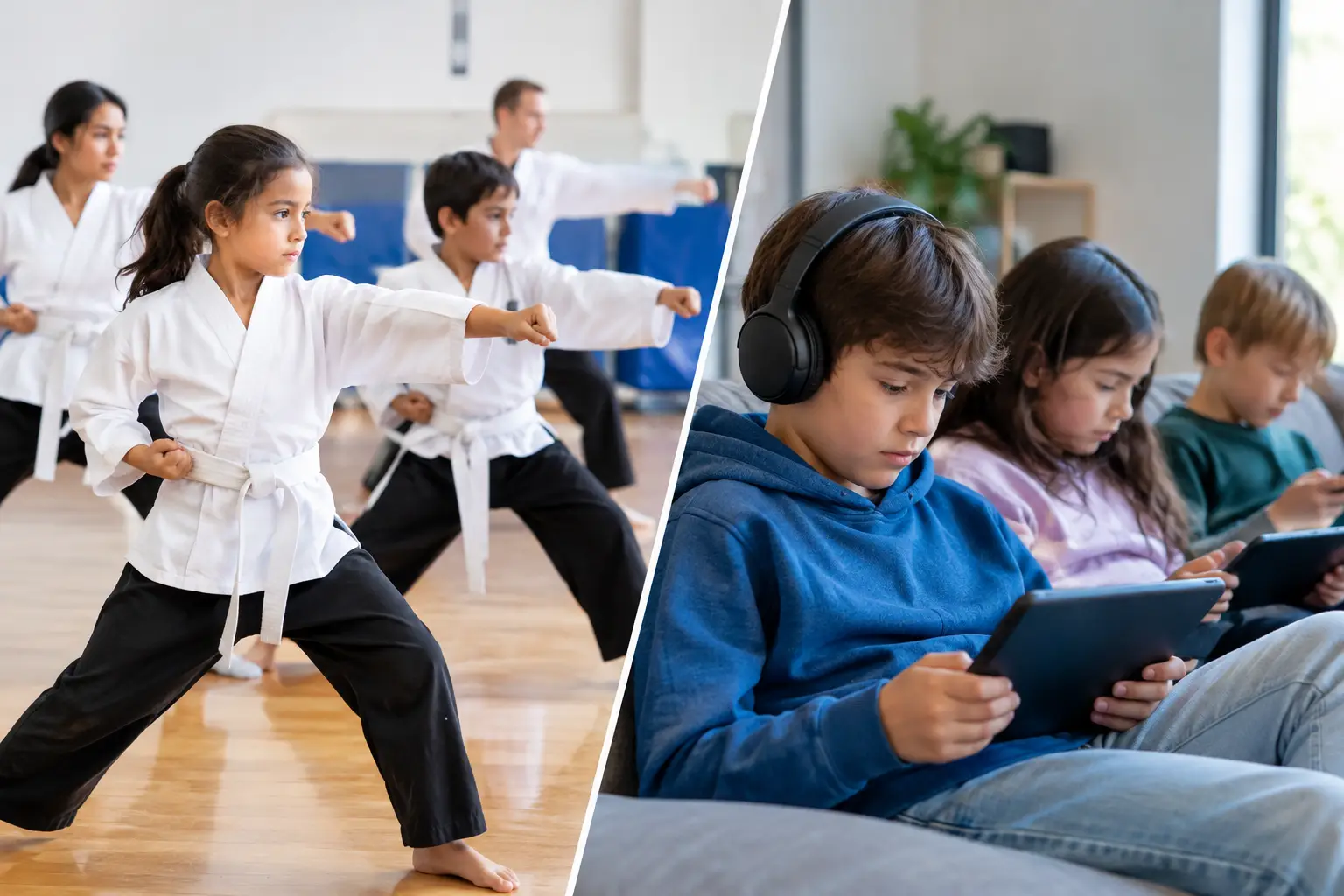
The familiar after-school pattern can happen quickly: bags dropped at the door, a snack, then a tablet, gaming console or mobile phone.
Martial arts versus screen time is not really a contest between something good and something bad. Screens are part of school, communication, entertainment and modern family life.
The more useful question is whether children and teenagers also have regular opportunities to move, concentrate, interact face-to-face and work through challenges away from a device.
For many Gold Coast families, martial arts provides a practical part of that balance. It creates regular times when children are expected to be present, listen, move and contribute to a group.
A child researching a school project, video-calling a grandparent, watching a program and playing an online game are using screens in different ways.
Treating every minute as equally harmful is neither realistic nor supported by the research.
Problems are more likely when recreational screen use regularly pushes out other important parts of life, including:
Some children can stop easily when asked. Others find it difficult to leave a game, video or conversation midway through it.
Parents do not need to monitor every minute perfectly. What helps is having predictable routines that leave room for more than one kind of experience.
Many parents have an underlying concern that fast digital rewards may affect a child’s motivation, attention or willingness to work towards slower goals.
There is some evidence behind this concern, but the stronger claims remain unconfirmed.
Some digital activities provide rapid and repeated feedback through points, levels, notifications, likes and other rewards. Research suggests that social feedback can engage reward-related brain processes and encourage continued participation.
A Nature Communications study analysed more than one million social-media posts. The researchers found that posting behaviour followed principles of reward learning and that social rewards influenced subsequent behaviour.
A JAMA Pediatrics study also found an association between habitual social-media checking and changes in adolescents’ sensitivity to anticipated social rewards and punishments.
However, the researchers could not determine whether social-media use caused those changes or whether pre-existing differences contributed to habitual checking.
This does not mean that ordinary screen use damages the brain, destroys discipline or makes children unable to enjoy slower activities.
The National Academies’ review of social media and adolescent health concluded that current evidence does not support claiming that social media causes changes in adolescent health across the population.
Effects appear to vary according to the young person, the type of use, the content and the platform features involved.
The responsible conclusion is that digital rewards can help explain why some activities are difficult to leave, but research has not established that screens broadly ruin motivation or discipline.
In martial arts, progress is connected to physical participation, cooperation, correction and repeated practice.
A student cannot watch someone else perform a technique and receive the same benefit as practising it themselves. They need to participate, apply feedback and return often enough for their skills to improve.
The rewards are usually gradual:
This helps students experience the relationship between sustained effort and improvement.
It does not make martial arts automatically superior to every digital activity. It simply provides experiences that screen-based entertainment cannot fully replace.
A well-structured martial arts class asks students to:
Children should still enjoy training. Classes can include purposeful games, padwork, agility, basic striking, throws, ground defence, kata and age-appropriate self-defence.
Beneath the enjoyment is a clear structure: arrive, listen, participate, receive feedback and finish with purpose.
Martial arts cannot guarantee that a child will become focused, motivated or disciplined. Family life, sleep, school, health and personality all contribute to a child’s development.
There is, however, encouraging research.
A randomised field experiment involving 240 children examined an 11-week beginner Taekwondo course.
Children who participated improved in some measures of attentional control and executive attention. They also reported stronger expectations and motivation to use self-regulation.
Not every measure improved, and one study cannot prove that all martial arts programs will produce the same results.
The quality of instruction, class environment and consistency of attendance matter. The research does support the idea that structured martial arts can provide meaningful opportunities to practise attention and self-control.
Replacing screen time with an activity that feels unsafe, excessively difficult or constantly serious is unlikely to create lasting motivation.
At Southern Cross Martial Arts, training is adjusted for the age and development of the student.
Younger children learn through short instructions, repetition and purposeful games. As students mature, they take greater responsibility for their conduct, fitness, technical understanding and progress.
Our curriculum rotates through eight connected areas:
This variety helps maintain interest while giving students repeated opportunities to improve their foundations.
Families can also read more about how martial arts may support children’s focus, listening and coordination.
The Australian Government’s recommendations for children and young people encourage those aged 5 to 17 to accumulate at least 60 minutes of moderate to vigorous physical activity each day.
They also recommend limiting sedentary recreational screen time to no more than two hours per day, breaking up long periods of sitting and avoiding screens during the hour before sleep. Educational screen use is considered separately.
One or two martial arts classes do not provide all the activity a child needs, but they can become reliable anchors within a more active week.
Families can make training easier by:
“You have training tonight” communicates belonging and responsibility.
“You cannot use your tablet because you have to train” can make a positive activity feel like a punishment.
A healthy balance does not require making screens the enemy.
Children can relax with a program, enjoy games with friends, learn online and communicate with family. Adults also use screens for work and entertainment, so the example set at home matters.
The goal is variety.
Martial arts can provide a reliable counterweight through real movement, practical challenges, direct feedback and face-to-face relationships.
When children regularly practise effort, respect and self-control alongside physical skills, screen time can remain one part of their week rather than filling every available space.
That balance is built patiently, one routine and one class at a time.
Book an introductory martial arts trial with Southern Cross Martial Arts.