
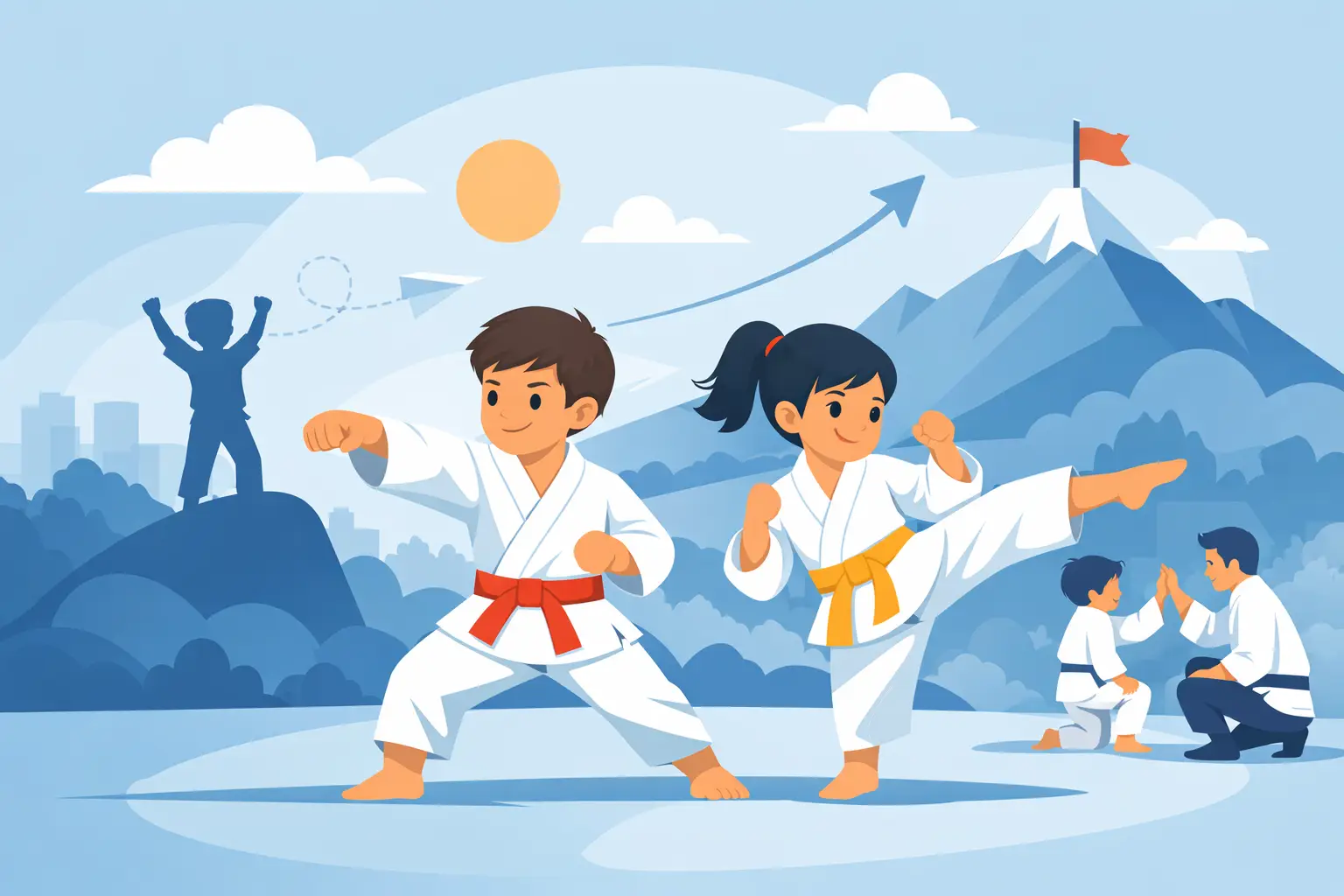
A child who hangs back at school drop-off, avoids trying new activities or worries about getting something wrong does not need to be told to “be confident”. They need regular opportunities to practise courage in a setting where effort is noticed, mistakes are safe and progress is real. That is how martial arts builds confidence in children: one achievable challenge at a time.
For many Gold Coast parents, the difference is not that their child suddenly becomes loud or fearless. It is quieter and more meaningful. They stand taller, speak more clearly, join in sooner and recover faster when something does not go their way. Martial arts gives children a structured place to develop those habits while learning practical skills, getting active and belonging to a positive community.
Confidence is not simply a personality trait. It grows when a child learns, through experience, that they can listen, practise, improve and handle a setback. Martial arts creates that cycle every week.
A new student may begin by learning how to stand safely, follow a simple drill or hold pads correctly. Later, they might remember a sequence, earn a new belt level, practise a controlled partner exercise or help a newer student. Each step offers evidence that their effort matters.
This matters especially for children who find team sports intimidating. In football, netball or other competitive activities, a child can feel they have let everyone down after one mistake. Martial arts includes partner work and teamwork, but personal progress remains central. Children can work at an appropriate pace while still being encouraged to step outside their comfort zone.
The belt system is valuable because it makes progress visible, but the real confidence comes from the work behind it. A child learns that a higher grade is earned through attendance, focus, practice and respectful behaviour, not handed over for simply turning up.
That process gives children a healthier way to view challenges. Instead of saying, “I can’t do this”, they begin to understand, “I can’t do it yet.” A kick that feels awkward in the first lesson may become controlled after a few weeks. A child who is nervous about speaking in front of the class may grow comfortable calling out a response during training. These are small wins, but they carry into school, friendships and family life.
Children build confidence when adults set clear boundaries and make expectations predictable. A well-run martial arts class has routines: lining up, listening, taking turns, practising with control and showing respect to training partners. For younger children, these routines are often as valuable as the physical activity itself.
Safety is central. Good instructors match activities to age, maturity and experience, teach control before intensity, and supervise partner work closely. Children should not be pushed into sparring, grappling or self-defence situations beyond their readiness. Confidence built through fear or humiliation is fragile. Confidence built through capable, supportive coaching lasts.
At Southern Cross Martial Arts, children can experience age-appropriate training across karate, Brazilian Jiu Jitsu, striking, wrestling, throwing and practical self-defence. Exposure to different skills helps children see that there is more than one way to succeed. One child may enjoy the focus of traditional karate, while another finds confidence through the problem-solving of BJJ or the energy of pad work.
Every child will have difficult days. They may forget a drill, lose position during grappling practice or struggle to coordinate a new technique. Martial arts does not remove those moments. It teaches children what to do next.
With patient instruction, they learn to reset their stance, ask a question, take a breath and try again. This is resilience in practical form. The goal is not to make children believe they will win every time. It is to show them they can remain composed, respectful and persistent when the result is not what they wanted.
Controlled partner training can be particularly helpful here. Children learn that being corrected is not the same as being criticised, and that a training partner is there to help them learn, not embarrass them. They also learn to win fairly and lose with good manners. Those lessons can reduce the urge to quit at the first sign of difficulty.
Parents sometimes worry that martial arts might make a child aggressive. Quality training should do the opposite. Children are taught that physical skills come with responsibility, self-control and respect.
Practical self-defence is not about starting fights or proving toughness. It is about awareness, personal boundaries, using a clear voice, creating distance and seeking help when needed. A child who feels more capable is often less likely to react impulsively or feel the need to show off. They know strength includes walking away.
This distinction is important when families are concerned about bullying. Martial arts cannot promise to prevent every difficult social situation, and it should never replace school support or a serious conversation with teachers. What it can do is help children develop stronger body language, clearer boundaries and the calmness to respond rather than panic. For some children, simply knowing they have practised safe responses can make school feel less daunting.
An instructor’s approach has a major effect on a child’s confidence. Children notice whether adults only praise natural ability or recognise concentration, courage, kindness and effort. The best coaching is encouraging without being empty. It tells a child what they did well, what they can improve and why the next attempt matters.
Professional instructors also model calm behaviour. When children see adults manage pressure with patience and respect, they have a practical example to follow. Over time, the dojo becomes a place where they are known by name, held accountable and encouraged to contribute.
That sense of belonging is powerful. A child does not have to be the fastest, strongest or most coordinated person in the room to feel valued. They need to know they are part of a group that notices their progress and expects them to keep trying.
Not every martial arts program will suit every child. A shy four-year-old, an energetic eight-year-old and a teenager looking for fitness will need different coaching, class structure and challenges. A trial class is useful because it lets parents observe how instructors communicate and how their child responds.
Look for a welcoming environment where beginners are supported, instructions are clear and older or more experienced students train with control. Notice whether the class has a balance of fun, movement, discipline and skill development. Children should leave feeling pleasantly challenged, not overwhelmed or ashamed.
It also helps to keep expectations realistic. Some children become comfortable immediately; others need several lessons before they participate fully. Regular attendance matters more than a perfect first class. Confidence grows through repetition, familiar faces and the experience of returning after a hard day.
At home, parents can reinforce the process by asking specific questions. “What did you practise today?” or “What was tricky, and how did you handle it?” usually leads to a better conversation than “Did you win?” Praise the effort to attend, listen and keep practising. This shows children that their character matters as much as their technique.
The benefits of martial arts are most meaningful when they appear outside the training space. Parents may notice their child taking more responsibility for getting ready, concentrating longer on a task or speaking with more assurance to adults. Teachers may see improved persistence. Children may feel more comfortable joining a game, trying a new activity or dealing with a disagreement without immediately becoming upset.
None of this happens overnight, and martial arts is not a substitute for individual support where a child is experiencing anxiety, bullying or other significant challenges. Yet as part of a child’s weekly routine, it can be a remarkably steady source of growth.
The aim is not to create a child who never feels nervous. It is to help them recognise that nerves can sit alongside action. When a child learns to step onto the mat, listen, try, regroup and return next week, they are building confidence they can carry wherever life asks them to be brave.