
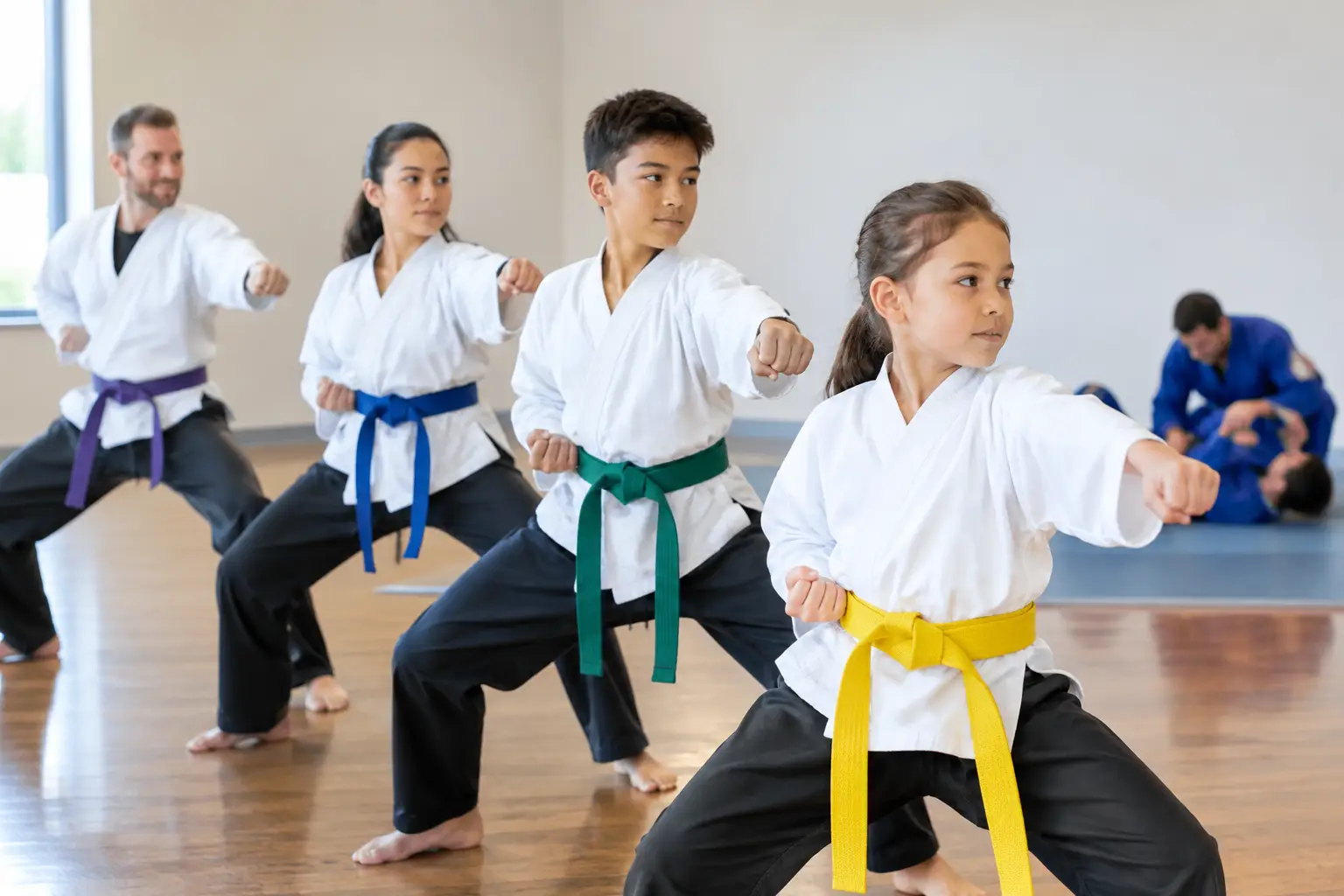
A child’s first martial arts class may look simple. They learn where to stand, listen for a cue, practise a movement and share the training space safely.
These early experiences are where meaningful martial arts progression begins.
Progression is not simply collecting belts or learning increasingly complicated techniques. It is the gradual development of physical skills, confidence, self control and responsibility for learning.
At Southern Cross Martial Arts, the class structure and belt system change as students mature. Younger students receive clear guidance and achievable steps. Older students are expected to understand more, practise with greater independence and take increasing responsibility for their own development.
Belts provide useful goals and recognise that a student has reached a new stage. However, the belt is only the visible part of progress.
Students are also learning to:
Move with better balance and coordination
Apply techniques with greater control
Train safely with different partners
Accept feedback and make adjustments
Remain composed when something is difficult
Understand why a skill is being practised
Take responsibility for their effort and preparation
Help create a positive training environment
A student can improve in several of these areas before receiving another belt.
This is why martial arts progression should not be rushed. A belt should represent genuine development rather than simply time spent attending classes.
Young children need classes designed around their physical, intellectual, emotional and social development.
Instructions must be clear, activities need to change regularly and learning should include purposeful games and repetition.
At this stage, the instructor carries most of the responsibility for organising the learning. Children are guided through activities that develop listening, balance, coordination, safe movement and cooperation.
The student may not yet understand the larger curriculum. They simply know that they are learning a stance, striking a pad, moving through an activity or working with a partner.
Behind those activities, the instructor is building the foundations that will support later martial arts training.
Learn more about our Junior Dragons program.
Southern Cross Martial Arts uses a rotating curriculum based on eight main skill areas:
Technical striking and blocking
Fitness
Ground defence
Throwing and displacement
Pad work and coordination
Sparring and agility
Kata and focus
Self defence
These areas give students experience across different ranges and types of movement.
The rotation also means that progression is not based on one favourite activity. A student may feel confident striking pads but need more work on balance, ground movement or kata. Another student may enjoy grappling but need to develop fitness or controlled partner work.
Returning to each skill area allows students to revisit familiar material with greater understanding.
A stance learned as a beginner may later support stronger striking, better balance during a throw or safer movement under pressure. Repeating a skill does not mean the student has stopped progressing. It means they are adding depth.
As students move into Red Dragons, they are ready for greater technical detail, physical challenge and responsibility.
Our Red Dragons belt system uses three stages within each colour:
White Stripe
Black Stripe
Half Belt
These stages allow progress to be recognised without rushing a child through full belt colours before the required skills have developed.
Red Dragons continue working through the eight skill areas. Skills can be recognised on the belt as students demonstrate improvement across the curriculum.
This helps children and parents see that progression is broader than performing one grading routine. Students must develop across striking, fitness, ground defence, throwing, pad work, sparring, agility, kata and self defence.
The system provides achievable steps while maintaining standards.
At this age, students still need encouragement and clear instructor guidance. However, they are also expected to listen more carefully, remember previous material and begin recognising which areas require additional practice.
Learn more about the Red Dragons program.
Progressing into Youth is more than moving into a longer or harder class.
The learning relationship begins to change.
Youth students are developing the ability to think critically, understand why they are practising a skill and take greater responsibility for their own progress.
The belt structure reflects this change. Youth students move through two stages for each belt colour rather than the three stages used in Red Dragons. Their progress is no longer divided into as many small steps.
They also begin using their training books more independently.
The books help students understand their syllabus, identify what they have learned and recognise what still needs attention. They can use them to prepare questions, review requirements and take more ownership of their practice.
The book does not replace instruction. It gives the student a tool for becoming an active participant in their own development.
An instructor can provide the pathway, explanation and feedback. The Youth student must increasingly bring attention, effort and curiosity.
Age is important, but it is not the only consideration when moving a student into a new program.
Instructors may also consider:
Physical development
Social maturity
Ability to work safely with older students
Need for greater challenge
Technical understanding
Confidence in a different class environment
Ability to accept more responsibility
Some students are physically ready before they are socially comfortable. Others need greater challenge even though they still benefit from support during the transition.
Moving with familiar peers can also help students feel more confident when entering Youth training.
The aim is not to keep a student in the easiest environment. It is to place them where they can continue learning safely and meaningfully.
Read about our Youth martial arts program.
Adult students progress through full belt colours without the smaller interim stages used in the children’s programs.
This reflects a further shift in responsibility.
Adults are expected to manage their attendance, review their skills and ask questions when something is unclear. The instructor continues to guide development, but the student must take responsibility for consistent practice.
Progress also becomes less about accumulating techniques and more about understanding them.
An adult student may revisit basic striking, kata, throwing or ground defence many times. Each return should add better timing, control, decision making and practical application.
Experienced students also begin connecting the different parts of the curriculum. They learn how distance can change from striking to clinch, how balance affects throwing and how self defence decisions depend on the situation rather than a memorised response.
A younger child gains confidence by completing an activity with support.
A Red Dragon gains confidence by recognising progress across the eight skills.
A Youth student gains confidence by using their training book, preparing for a requirement and taking ownership of improvement.
An adult gains confidence through deeper understanding and the ability to apply skills with sound judgement.
At every stage, confidence is built from evidence.
The student experiences themselves learning, adapting and becoming more capable. They also discover that progress does not always happen at the same speed.
Some skills improve quickly. Others require patience. A strong martial arts pathway teaches students to value both achievement and the work required to reach it.
A good martial arts program should grow with the student.
The teaching methods, class expectations and belt structure should not remain identical from preschool through to adulthood. Each stage should prepare the student for what comes next.
At Southern Cross Martial Arts, progression gradually moves from instructor led learning towards greater student ownership.
The belts change. The classes become more demanding. The training books become more important. The student is expected to understand more and contribute more.
What remains consistent is the purpose: helping each person become a safer, more capable and more responsible martial artist.
The next belt matters, but the person developing underneath it matters more.
Book an introductory trial and begin your martial arts pathway.