
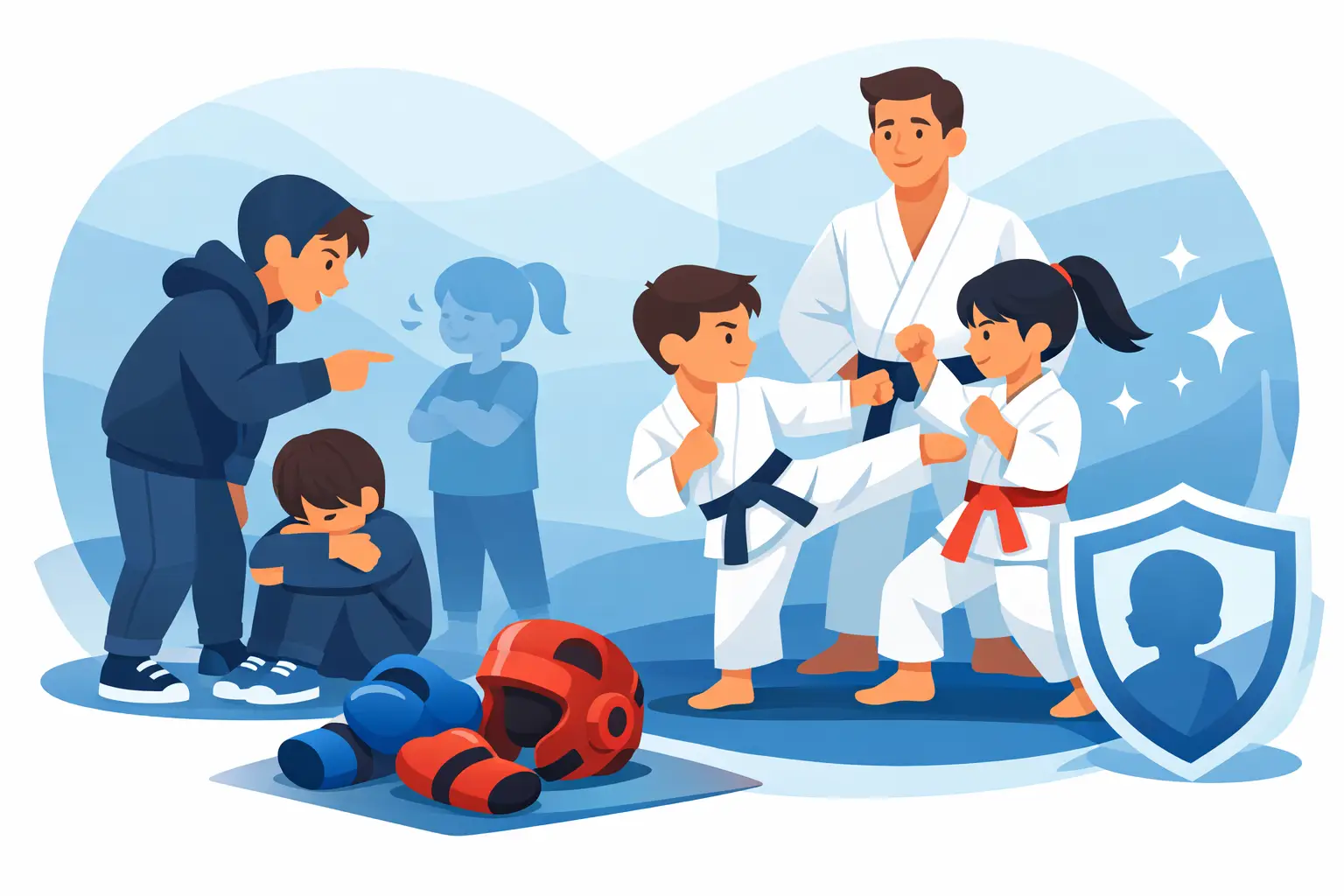
A child who is being targeted at school does not always come home with a clear story. They may suddenly complain of stomach aches, avoid the playground, become unusually quiet, or react strongly to small frustrations. For families, martial arts bullying prevention for kids can be a positive part of the support plan because it develops confidence, body awareness and calm decision-making – not because it teaches children to fight.
At its best, martial arts gives children a safe place to practise standing tall, using their voice, managing big emotions and asking for help. These are skills that matter in the schoolyard, on the sports field and throughout life.
Many parents understandably look for self-defence when their child has had a difficult experience. Practical skills do matter, particularly when a child needs to create space, get away safely, or protect themselves as a last resort. But physical techniques are only one small piece of effective bullying prevention.
Bullying often relies on a power imbalance. A child who appears isolated, unsure of themselves, or easily provoked can become an easier target. Martial arts training helps change the signals a child sends without asking them to become aggressive, loud, or someone they are not.
Through regular, age-appropriate practice, children learn to make eye contact, use a clear voice, hold a balanced posture and stay composed when challenged. They also learn that strength includes walking away, reporting unsafe behaviour and supporting others who are being excluded.
That is a far more useful lesson than telling a child to simply “stand up for yourself” without showing them what calm, safe action looks like.
A quality children’s program teaches skills in layers. Younger children may begin by learning personal space, listening, turns and simple verbal boundaries. As they grow, training can include more realistic self-defence concepts, situational awareness, controlled striking, throws or ground movement, always taught with clear safety rules and supervision.
The goal is not to turn children into fighters. It is to help them feel capable without feeling they need to prove anything.
Empty reassurance can wear thin when a child is worried about school. Telling them they are brave is helpful, but confidence becomes more believable when they have evidence of their own progress.
In martial arts, that evidence comes through small, repeatable wins: remembering a sequence, improving their balance, completing a challenging drill, helping a training partner, or working towards a new belt level. A child learns that they can feel nervous, make mistakes, keep practising and improve.
That mindset carries beyond the mats. When a peer tries to embarrass them or get a reaction, they have a stronger internal message to rely on: “I can stay calm. I know what to do next.”
Good martial arts instruction is built on respect. Students learn to listen when a partner says stop, use techniques with control and understand that every person has a right to physical space.
This makes boundary-setting practical rather than theoretical. A child can rehearse a firm voice, an open-handed protective stance and simple phrases such as “Stop. Don’t touch me” or “I’m leaving now.” They learn to move towards a safe adult or a group of friends, rather than staying in an unsafe situation to win an argument.
These skills are useful for everyday conflict too. Not every disagreement is bullying, and children need help recognising the difference. A one-off argument, a friendship issue and repeated targeted behaviour may each need a different response. Martial arts should strengthen a child’s judgement, not encourage them to treat every problem physically.
Children who are upset may freeze, lash out or say something that escalates the situation. Martial arts classes give them regular chances to experience pressure in a controlled environment. They might feel challenged by a new drill, frustrated when they cannot get a movement right, or nervous before demonstrating a skill.
With patient coaching, they learn to breathe, reset and try again. That ability to pause is powerful. It can help a child avoid being drawn into the reaction a bully wants.
Training also gives energetic children a constructive outlet. Physical activity, clear routines and focused goals can support concentration and emotional balance, particularly after a demanding school day.
The value of martial arts depends greatly on the environment. A class that celebrates intimidation, encourages uncontrolled sparring or treats toughness as the only measure of success is not the right fit for children.
Parents should look for professional instructors who understand child development and set firm expectations around behaviour. Classes should be organised by age and ability where possible, with techniques adapted to the child’s stage of development. Beginners should be welcomed, corrections should be respectful, and children should never be pressured to train through fear or injury.
At Southern Cross Martial Arts, children train in a structured, inclusive setting where discipline and encouragement work together. Our programs introduce practical skills drawn from karate, Brazilian Jiu Jitsu, Muay Thai, wrestling and self-defence in ways that are appropriate for each age group. Children build coordination and capability while learning that control, respect and responsibility come first.
Parents should also expect open communication. If a child is struggling with confidence, school worries or a particular social situation, a good instructor can help reinforce suitable class goals. They are not a replacement for parents, teachers or wellbeing professionals, but they can be a valuable positive role model in a child’s support network.
No activity can guarantee that a child will never experience bullying. It is important not to place that responsibility on the child. Bullying is never their fault, and the adults around them have a duty to act.
If your child shares concerns, listen without immediately rushing to solve the problem. Ask open questions about what happened, who was involved, how often it occurs and where it happens. Keep a record of repeated incidents, then speak with the school according to its bullying and behaviour procedures.
Martial arts can sit alongside these practical steps. It gives children a regular community outside school, with friends and mentors who recognise effort and character. For some children, that belonging is as meaningful as the physical training itself.
It also helps to avoid framing training as preparation for revenge or payback. A child who believes they must handle everything alone may avoid seeking help. The strongest message is this: use your voice, move to safety, get an adult, and use physical self-defence only when necessary to escape immediate harm.
Consistency matters more than natural talent. A child does not need to be sporty, outgoing or coordinated before starting. In fact, children who feel unsure in group activities often benefit from a patient class structure, clear routines and achievable goals.
Give the program time. The first few classes can feel unfamiliar, especially for a shy child. Celebrate attendance and effort rather than focusing only on belts, competition results or perfect technique. Ask questions such as, “What did you practise today?” or “When did you show perseverance?” This keeps the conversation connected to character as well as physical skill.
It is also worth observing whether your child enjoys the culture of the class. They should leave feeling tired in a good way, respected by instructors and increasingly comfortable among their peers. Challenge is healthy; humiliation is not.
A child does not need to become the loudest person in the playground to feel safe. Sometimes the most meaningful change is quieter: steadier posture, clearer words, a new friendship, and the confidence to know they deserve respect.