
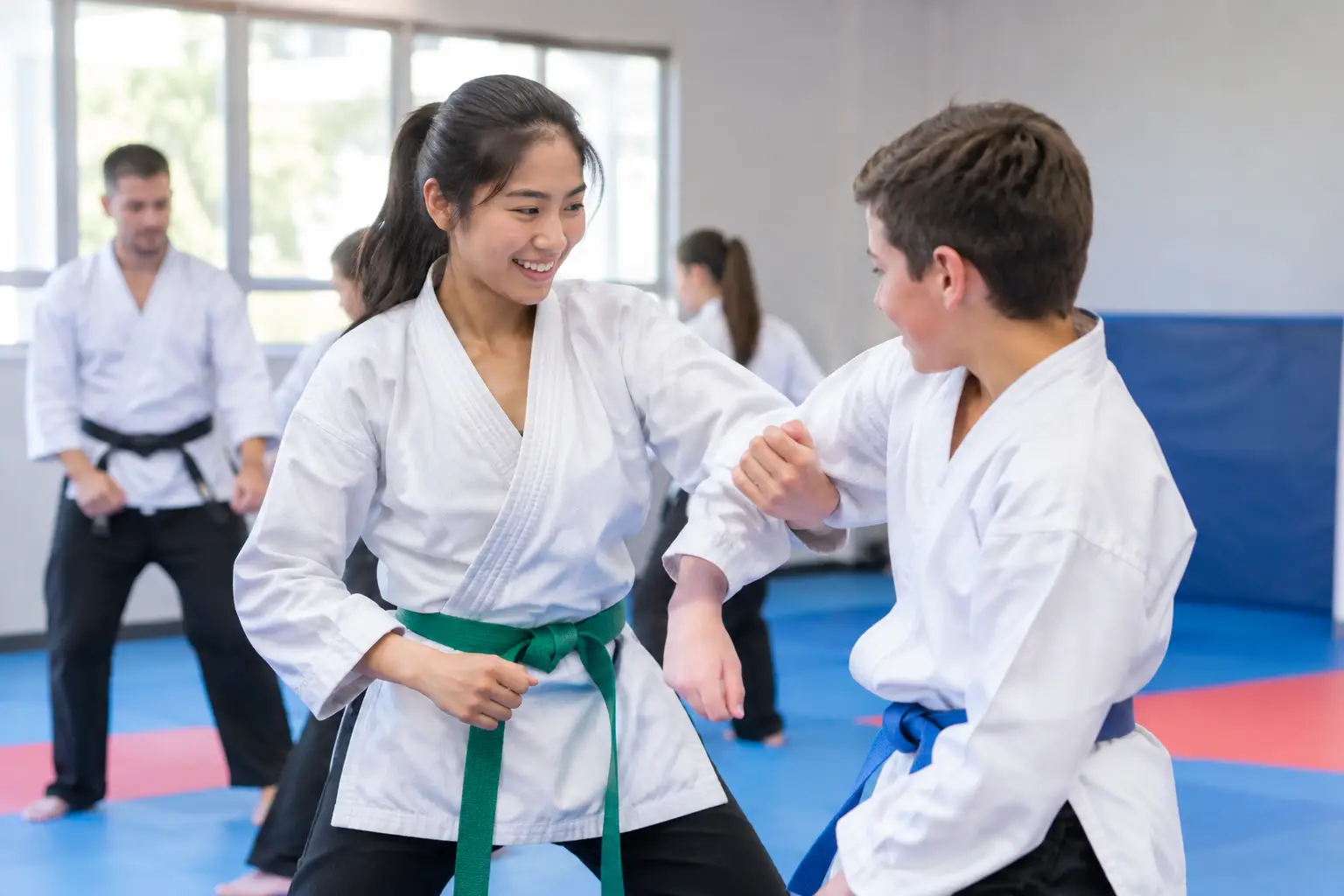
A young child learning to join a group, a teenager needing a positive physical challenge and an adult bored with the gym may appear to have very different needs.
Martial arts can offer each of them a place where effort is noticed, skills are earned and challenges are approached one step at a time.
After teaching Gold Coast families since 2006, we have seen that the techniques are only one part of the value. Students also learn how to listen, work with others, manage frustration and keep practising when something does not come easily.
Martial arts is not a quick solution to every challenge. Its benefits develop through good coaching, regular attendance and time.
Martial arts provides regular movement while giving students something meaningful to learn.
Instead of exercising simply to burn energy, students practise balance, coordination, footwork, striking, grappling, throwing and practical movement skills.
At Southern Cross Martial Arts, our Freestyle curriculum rotates through eight main skill areas:
This variety keeps training interesting while helping students develop a broad foundation.
Children enjoy moving and playing while learning physical skills. Teenagers receive a challenging activity that demands real attention. Adults can improve their fitness while learning something more engaging than completing another repetitive gym workout.
Students do not need to be fit or naturally athletic before beginning. The purpose of training is to help them improve from their own starting point.
Children are not small adults. A quality children’s class should suit their stage of physical, social and emotional development.
At SCMA, games and Game Sense activities are used to teach skills in an enjoyable way. A child may see a game involving balance, movement or escaping from a partner. The instructor sees an opportunity to develop coordination, decision making, cooperation and body awareness.
Fun does not mean that standards disappear.
Children are still expected to listen, take turns, respect their partners and make an honest effort. Enjoyment helps them remain engaged long enough for those habits and skills to grow.
Our age appropriate programs allow the coaching methods, activities and expectations to develop as the student grows.
Confidence is not created by repeatedly telling someone to be confident.
It develops when students experience genuine progress.
A child may initially feel unsure about joining a group or working with a partner. With support, they complete the first activity. Later, they remember a sequence, hold pads correctly, escape from a position or demonstrate a skill in front of the class.
Each achievement provides evidence that they can learn something that once felt difficult.
This does not mean every student becomes loud or outgoing. Some develop a quieter confidence. They become more willing to try, recover faster after mistakes and feel less threatened by unfamiliar challenges.
The same principle applies to teenagers and adults. Ability is developed through practice. It is not decided during the first class.
Discipline is sometimes confused with strictness. We see it as learning to do what is needed, even when it is not the easiest option.
In class, this may mean listening while a skill is explained, practising carefully, controlling power with a partner or returning to a difficult task.
Our Chat on the Mat discussions give children language for the qualities they are practising. Monthly topics include courage, responsibility, fairness, persistence, focus, respect, teamwork, confidence, communication and resilience.
We then connect those ideas to what happens during training.
A student can practise persistence when a technique feels awkward. They can show fairness while working with a less experienced partner. They can demonstrate leadership by helping someone without trying to take over.
These conversations do not guarantee perfect behaviour at home or school. They give children practical examples and a familiar framework that parents and instructors can reinforce over time.
Read how martial arts can help children practise focus.
Every martial artist loses balance, forgets a movement or finds a new skill difficult.
In a supportive class, mistakes are treated as part of learning. The student is encouraged to adjust, listen again and have another attempt.
This is particularly valuable for children who quickly decide they are bad at something when success does not come immediately.
Martial arts gives them regular opportunities to be a beginner and discover what consistent practice can achieve.
Partner training adds another layer. Students learn to cooperate, manage their strength and respond appropriately when something does not go their way. They can be challenged without being careless and competitive without treating their training partners as enemies.
Some families begin martial arts because they are concerned about bullying, personal boundaries or safety.
Physical skills are important, but practical self defence begins with awareness, judgement and confidence. A person must recognise when a boundary has been crossed and believe they have the right to respond.
Those boundaries may be physical or emotional. A child, teenager or adult may need to say no, use a stronger voice, create distance, leave the situation or ask someone for help.
Sometimes people hesitate because they do not want to appear rude, overreact or get into trouble. Good Self Defence Training can help students develop the confidence to trust their judgement and give themselves permission to act.
For children, the strongest response will often be moving away and finding a trusted adult. However, if someone cannot safely leave and physical action becomes necessary, they should have the confidence and skills to protect themselves using reasonable and necessary force.
Confidence does not mean looking for conflict. It means knowing your boundaries, communicating them clearly and being prepared to act when those boundaries are ignored.
Learn more about children’s self defence training.
Martial arts can change as the student matures.
A young child may begin with balance, listening and simple movement. Older children can take greater responsibility for technique, partner safety and their behaviour. Teenagers and adults can explore more demanding striking, grappling, fitness and self defence skills.
There is always another layer to understand. That depth allows martial arts to remain meaningful beyond the first few months.
The right school should provide professional instruction, suitable challenges and a culture where beginners feel welcome without lowering the standards that make progress worthwhile.
Meet the Southern Cross Martial Arts instructor team.
The best reason to learn martial arts is not that it will make life perfect. It is that regular training provides a dependable place to move, learn, face challenges and gradually become more capable.